

Introduction
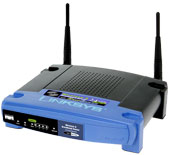
| At a Glance | |
|---|---|
| Product | Linksys Wireless-G Broadband Router with SpeedBooster (WRT54GS) |
| Summary | 802.11g Router based on Broadcom “Afterburner” chipset. Does not support bridging and repeating |
| Update | 19 April 2004 – Corrected info in Internal Details 2 April 2004 – Clarifications in last section. |
| Pros | • Up to 50% best-case throughput improvement • Upgradeable antennas • Resonably-priced parental control service option |
| Cons | • Poor throughput vs. distance performance • Limited port filtering if you don’t use the optional parental control service • Very limited wireless monitoring |
Linksys’ WRT54G Wireless-G Broadband Router has been a very successful product and the most popular product review here on SmallNetBuilder. It’s also been a great product for Broadcom, whose wireless chipset has shipped in each and every one.
The WRT54GS Wireless-G Broadband router with SpeedBooster represents Linksys’ entry into the “enhanced” 802.11g wars. It’s based on Broadcom’s “Afterburner” technology, which Linksys says “increases wireless network performance by up to 35%”. Since this is my first review of an “Afterburner”-based product, I’ll look at this claim pretty closely in the Wireless Performance section.
Note that the WRT54GS and its companion WPC54GS Cardbus card don’t replace their existing non-SpeedBoosted siblings, but are being positioned as higher-performance alternatives – at higher prices, of course.
Basic Features
Linksys has revamped the user interface and slightly changed the feature set since the WRT54G’s review. Since this review is likely to also be well-read, I’ve reprised most of it here – with appropriate text and screenshot changes – so that you don’t have to click back and forth between this and the older review. The Performance sections are brand-new, however, so if you’re already familiar with the WRT54G’s feature set, you may want to skip right to there.
The WRT54GS (GS) comes in Linksys’ pre-Cisco purple and grey plastic box. All indicator lights are on the front of the box and are bright and viewable from a wide angle. All network connection indicators have been scaled back to single Link/Activity types for the four 10/100 LAN ports, WLAN (wireless LAN) and 10/100 Internet (WAN) ports. Power and DMZ general indicators (Diag has been dropped) round out the blinky stuff.
The DMZ indicator now properly lights whenever the DMZ feature – which opens up all ports to one selected LAN machine – is enabled. The WLAN light is now also a much better indicator of wireless activity, briefly shutting off when the WLAN link is passing traffic. It also extinguishes when you set the Wireless Network Mode selector in the admin interface to Disabled to shut off the router’s radio.
Four 10/100 LAN ports, one 10/100 WAN port and power jack are on the rear panel, along with the Reset switch, which now serves only a reset-to-factory-defaults function. Note that all ports are auto MDI / MDI-X (though Linksys doesn’t spec or mention this) which means they’ll figure out how to connect to whatever you plug into them, including switches if you decide to expand the number of ports.
Linksys didn’t include the wall-mounting plate that came with my original WRT54G, instead now offering it separately (as long as you want to buy ten of them). Also included are a CD with the User Guide (PDF), Windows-based Setup Wizard, trial version of Symantec’s Norton Internet Security Suite and LogViewer application. You also get printed Quick Install and Parental Control Quick Install pamphlets as well as a normal UTP Ethernet cable.
Internal details
The GS uses a very different board design than its predecessor (Figure 1).
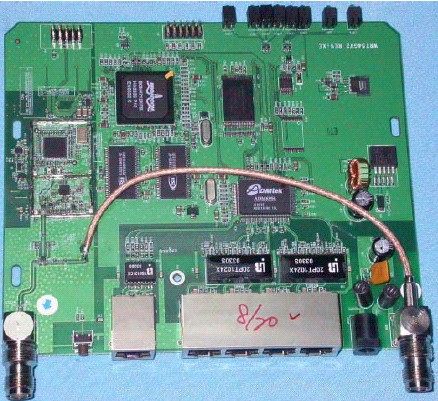
Figure 1: The WRT54GS board
The radio is now integrated onto the main board instead of using a separate mini-PCI radio. Linksys also tells me that it uses a different Broadcom chipset, that’s needed to support the “Afterburner” capability. This means that WRT54G’s can’t be upgraded to be equivalent to the “GS”. So if you want to play, you’ll have to pay.
The radio is cabled to two RP-TNC style connectors (that Linksys uses throughout its 802.11b product line) which have two moveable, jointed dipole antennas attached.
Something that hasn’t changed is that the GS is still based on Broadcom’s BCM4702 Wireless Network Processor, supported by RAM, Flash memory, and an ADMtek 6996 for the 10/100 WAN Ethernet port and four 10/100 switched LAN ports.
Updated 19 April 2004 A closer look at the GS’s design reveals that it’s based on Broadcom’s BCM4712“system-on-a-chip” instead of the 4702 and the ADMtek 6996 switch replaces a Broadcom BCM5325.
Setup and Administration
Linksys has revamped the admin interface for the GS. But if, unlike me, you’ve been upgrading your WRT54G on a regular basis, you’ve already pretty much seen what you’ll see for the GS’ controls. You can also run a Windows-only setup utility that walks you through choosing a WAN type and other setup steps, an option that I didn’t explore.
The GS comes set to 192.168.1.1 as its factory default and with its built-in DHCP server enabled. So all you’ll need to do is plug in a client that’s set to obtain its IP address information automatically, maybe do a DHCP release / renew (or reboot your client computer), and enter the default password into the login box that pops up. If all goes well, you’ll get the main Setup screen shown in Figure 2.
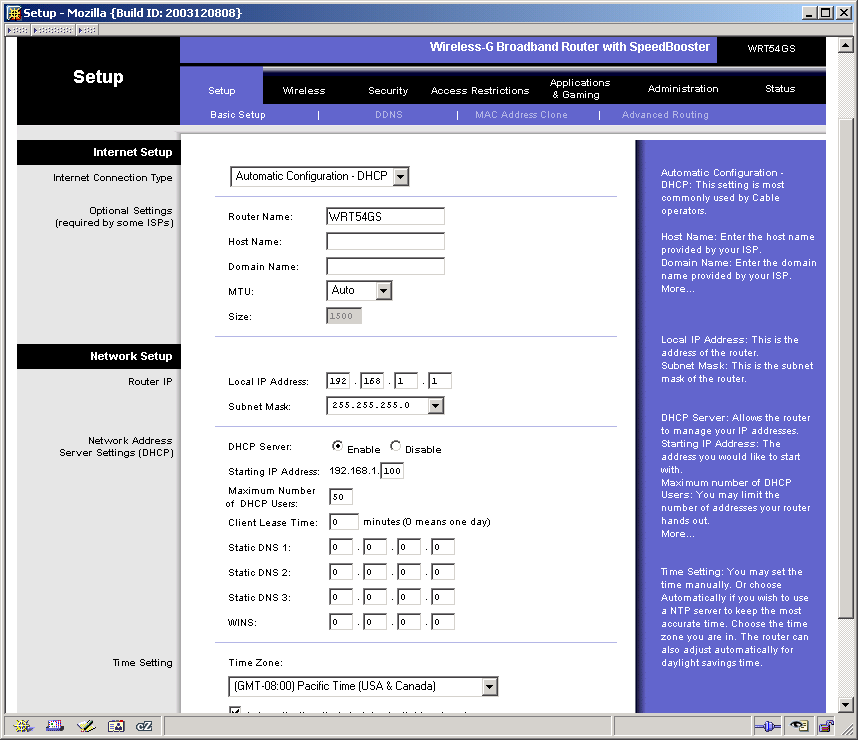
Figure 2: Setup screen
(click on the image for a full-sized view)
The selections on the Setup screen are pretty much what you’re used to with Linksys routers. The Internet Configuration Type selector automatically refreshes the browser screen to present settings appropriate to the choices of Automatic Configuration – DHCP, Static IP, PPPoE, PPTP and Heartbeat Signal (for Australian users) Internet connection types.
MAC address cloning gets its own page in the Setup section, as does setting up either dynamic DNS service from dynDNS.org or TZO, setting up static routes or disabling NAT features and converting the GS to a non-NAT router. Note that Wireless setup has been moved to its own section, which I’ll cover later.
The interface is generally quick, with quick mini-reboots needed to get the changes you make on each page to take. Multiple admin logins are allowed, with no warning given when two or more admins log on. Once you’re logged in, there’s no idle timeout, and you just need to remember to quit your browser when you’re done, because there’s no logout button.
Enabling Remote Management for the first time still pops up a message telling you to change the router’s default password and you can now enable secure (HTTPS) admin access. You can also change the default remote admin port from 8080, but can’t restrict access by IP address or domain. Also of note is that you can’t reboot the GS from the Admin interface.
Firewall Features
The GS’ firewall features are pretty much in line with other Linksys routers, with one exception I’ll cover shortly. You can forward up to ten port ranges (Figure 3), with TCP, UDP or both protocols, but triggered port forwarding isn’t supported.
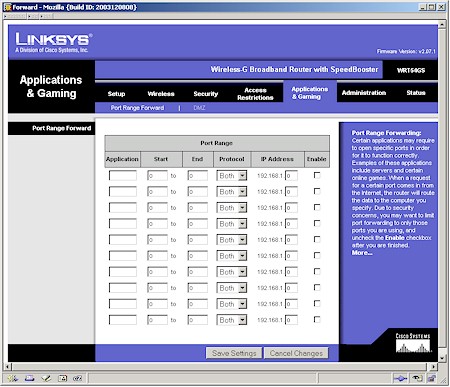
Figure 3: Port Forwarding
Port Forwarding entries are both editable and able to be disabled and left programmed and loopback is supported for servers on forwarded ports.
UPnP is supported (on the Administration tab) and enabled by default. But ports opened by UPnP NAT Traversal aren’t reflected in the GS’ admin interface. The router also supports putting one computer in DMZ via a setting on the Security tab of the interface.
Internet access control is provided via the Access Restrictions features shown in Figure 4, which I still find confusing and is one of the product’s weakest features.
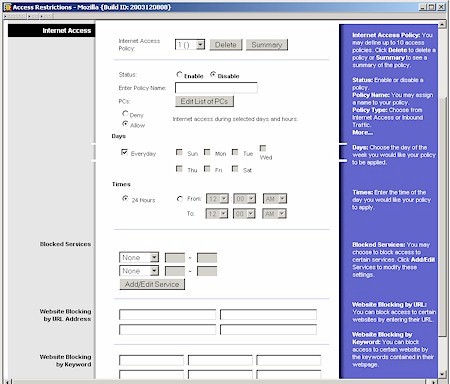
Figure 4: Access Restrictions
The Access Policy is schedulable by day and time, and up to 10 different policies can be created. Each policy has its own schedule and group(s) of LAN computers that it applies to, but is an all-or-nothing proposition. The Access Policy either grants all or denies all Internet access, and can’t be limited to specific ports.
Specific port filtering is controlled by the Blocked Services settings, but these settings can’t be scheduled, apply to all LAN machines, and you only get two. You can add service definitions that aren’t included in Linksys’ default list, though.
Website blocking is provided for four URLs and six keywords, but there’s no ability to block Web Proxies, ActiveX, Java, and Cookies. You also can’t define a “trusted users” who can bypass all these Internet access controls.
If these controls don’t suit your needs, you can enable the new Parental Control feature. This is a charge-for rebranded service created by Netopia that’s intended to provide controls similar to those you get on AOL and MSN. You can establish profiles for each user that include the Internet services (AIM, email, web, etc.) they can use and the categories of websites they can view. You also get detailed Internet usage reports for each registered user.
I didn’t check out the service, but if you can visit Netopia’s site, or Linksys’ info page to learn more. You get a free 30 day trial with the WRT54GS, and Linksys sweetens the deal by cutting the service price by 20% if you sign up within the first 15 days of the trial. (Since Linksys also throws in an extra month of service for early takers, the discount is actually closer to 25%.)
I’ve complained to consumer networking companies for some time that they needed to improve their parental control and reporting features, so I’m glad to see Linksys finally take up the challenge. Although it’s a charge-for service, I think $40 a year ($50 non-discounted) is reasonable when you consider that – unlike virus-protection deals – it covers all users beind the router. It’s also is a lot cheaper than what you’d pay to AOL or MSN for similar capability. However, I’d like to see Linksys (or Netopia) fix the application so that it works with current versions of Mozilla. When I tried to even view the sign up info with Mozilla 1.6b, I got the following:
To view these pages, please use either Netscape 7.0 or above for Windows, Internet Explorer 5.5 or above for Windows, or Internet Explorer 5.1 or above for Macintosh.
VPN
VPN passthrough is provided for PPTP and IPsec and now also L2TP. All are enabled by default and separate disables are provided on the Security > VPN page. Linksys says multiple passthrough sessions are supported for each VPN type and tunnels can terminate at multiple remote gateways.
Port forwarding is supported for one IPsec and L2TP server if you want to host your own VPN gateways. But if you’re looking to host a PPTP server, you can’t, since port forwarding isn’t supported for the special protocol that PPTP requires.
Logging & Other Features
The GS’ logging features are the usual Inbound and Outbound traffic logs that you’ve come to expect with Linksys routers. Note, though, that neither Linksys’ SNMP Trap mechanism nor syslog daemons are supported for external log analysis and storage. You also can’t save logs to a file, but you can clear them.
Other features include the ability to disable the Internet Sharing function and use the GS as a non-NAT router. When in this mode, you also get to control the interfaces (but not the direction) that Dynamic Routing RIP-1 and 2 messages are allowed on. You can also define up to 20 Static Routes in either Gateway or Router modes.
That wraps up the firewall’s features. Let’s move on to routing performance.
Routing Performance
Testing Notes:
• All tests were run with LAN endpoint in DMZ
The test results show the GS’ routing speed probably won’t be a problem. If about 34 Mbps isn’t fast enough for you, you probably shouldn’t be using this class of router!
I was happy to find that I didn’t have any problem running Qcheck’s UDP streaming tests, which I sometimes have with SPI + NAT routers. This says to me that Linksys has done some tuning since the original WRT54G’s code.
Routing Performance Test Results
| Test Description | Transfer Rate (Mbps) | Response Time (msec) | UDP stream | |
|---|---|---|---|---|
| Throughput (kbps) | Lost data (%) | |||
| WAN – LAN | 33.7 | 1 (avg) 1 (max) |
500 | 0 |
| LAN – WAN | 33.9 | 1 (avg) 1 (max) |
500 | 0 |
| Firmware Version | 2.07.1 | |||
See details of how we test.
Wireless Features
Wireless settings have been organized into their own section with separate pages for Basic, Security, MAC address filtering and Advanced features. Figure 5 shows the more interesting Advanced settings, which include the ability to disable 11b Protection Mode (CTS Protection Mode) and Frame Bursting.
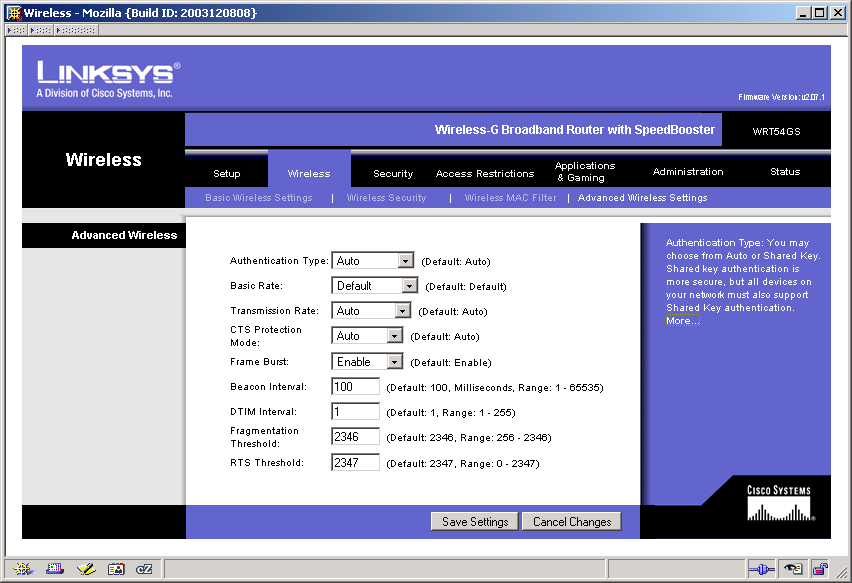
Figure 5: Advanced Wireless Setup screen
(click on the image for a full-sized view)
Basic wireless controls include setting the Network Mode to Mixed, B-Only, G-Only or disabling the radio entirely. There’s nothing new in the MAC Address Filter section which still lets you enter 40 MAC addresses of clients that will be denied or allowed access to your Wireless LAN.
The feature also still uses three different windows to view and set MAC addresses, which I find confusing to navigate. The good news is that you still get a list of currently connected wireless clients that you can just select to have copied to the MAC address list window. The bad news is that the list of filtered MAC addresses can be neither saved or loaded to/from a file.
TIP: This is actually a wireless association control, so if you have the Prevent mode set and a wireless client’s MAC address entered, not only will they be denied Internet access, but more importantly access to all your wired and wireless LAN clients.
The GS includes a full set of wireless encryption and authentication options, including support for Wi-Fi Protected Access’ (WPA) “Enterprise” (RADIUS) and Pre-Shared Key (PSK) modes. The GS can also pass WEP-encrypted authentication requests to an external RADIUS server (Figure 6).
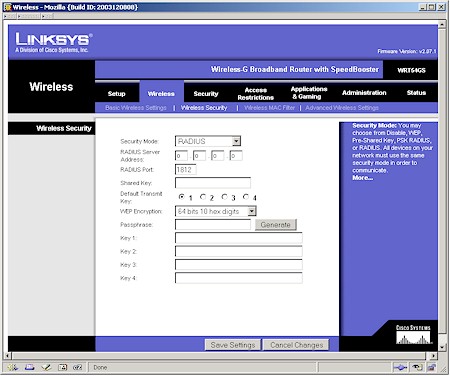
Figure 6: RADIUS settings
WEP is also supported, but I strongly recommend you use at least WPA-PSK mode due to its improved security. You can enter 64 or 128 bit keys either in Hexadecimal or via an alphanumeric passphrase. The passphrase method generates four different keys, which unfortunately can’t be saved to a file, which would make client entry a little easier.
Like its predecessors, the GS disappoints in its ability to monitor wireless clients and provide information about wireless data flow or signal strength. The only way you have of knowing whether wireless clients are connected is still to enable the MAC Filter list, click the Edit MAC Filter List button, then click the Wireless Client MAC List button on the window that opens.
I was also disappointed to find that WDS-based Wireless Bridging still isn’t supported. I’m puzzled as to why Linksys hasn’t added this often-requested feature, but they haven’t. So if wireless repeating or bridging are on your list of must-haves for an 802.11g router, you’ll still need to look at Buffalo Tech’s WBRG54 (or just-introduced WBR2-G54) router instead.
Wireless Performance
• “Signal Quality” readings were not available
• Testing was done with a Linksys WPC54GS Cardbus client card in a WinXP Home Dell Inspiron 4100 laptop unless otherwise noted
I’ll first focus on the performance of the SpeedBoosted product pair themselves and then turn to some interoperability testing.
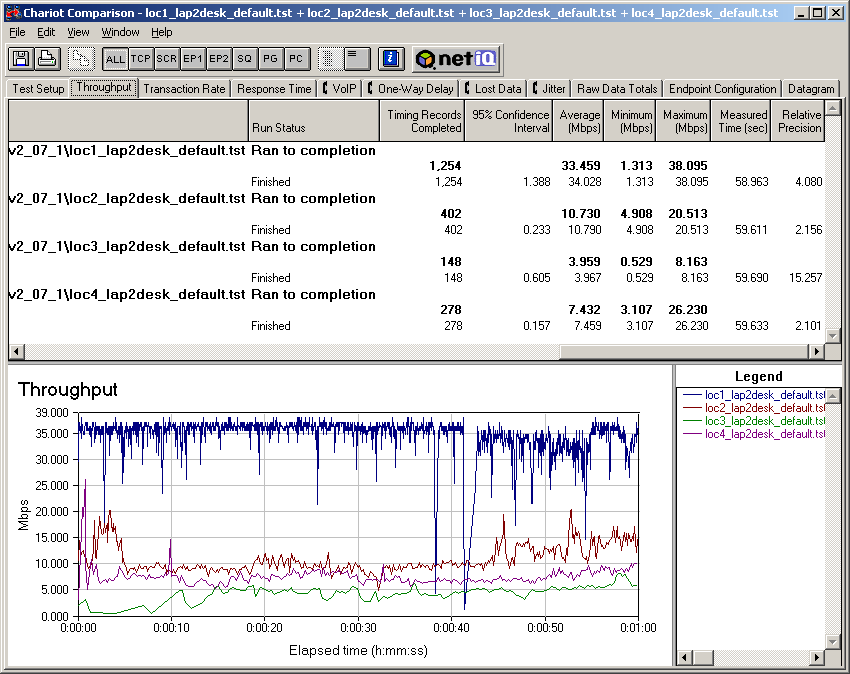
Figure 7: Four Condition Throughput test – WRT54GS and WPC54GS
(click on the image for a full-sized view)
Figure 7 is a real good news / bad news story. The good is that SpeedBooster (Afterburner) produces a significant performance increase (more on that shortly). The bad is that Broadcom’s new chipset – at least in Linksys’ implementation – has the same poor throughput vs. distance performance as its predecessor.
Because both my testing location, firmware and drivers have changed since I tested the WRT54G a little over a year ago, I re-ran a comparison test with the WRT54G and WPC54G, which is shown in Figure 8 below.
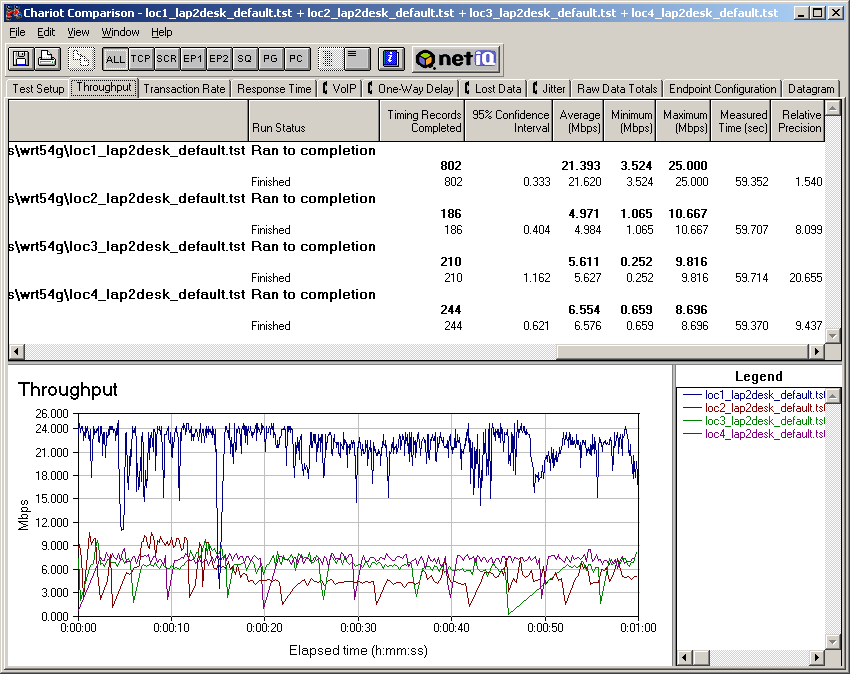
Figure 8: Four Condition Throughput test – WRT54G and WPC54G
(click on the image for a full-sized view)
You can see that both product generations have similar throughput vs. distance characteristics in that they drop down from their best-case speeds pretty quickly. So while Afterburner really does pour on the gas under strong-signal conditions, the speed advantage disappears pretty quickly once you get some distance and a wall or two between the router and client.
Before we press on to a detailed look at SpeedBooster, take a quick look at the Security mode performance.
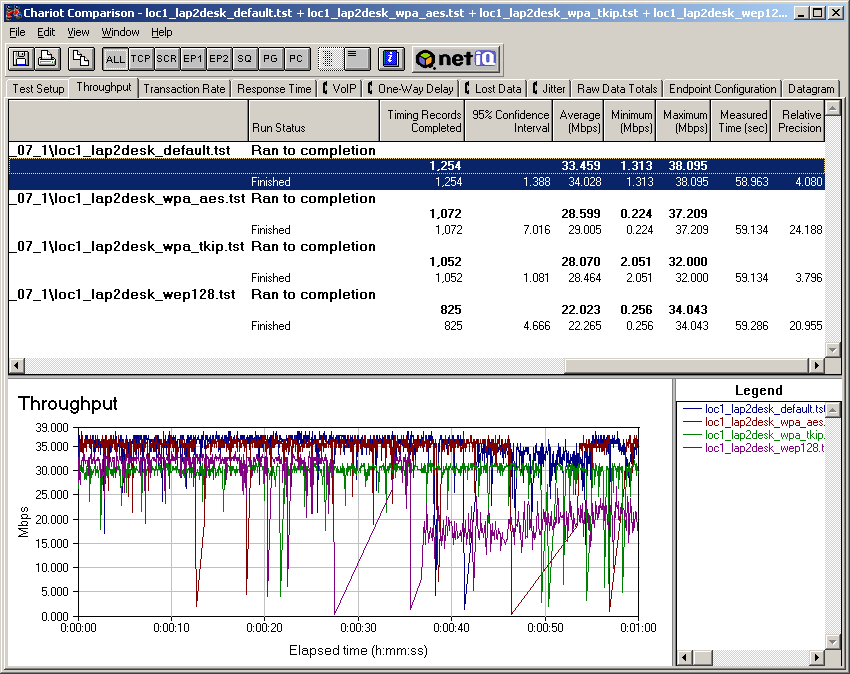
Figure 9: Security mode throughput comparison
(click on the image for a full-sized view)
Figure 9 shows a comparison of Location 1 (best case) runs with no encryption, WPA-PSK (AES), WPA-PSK (TKIP) and WEP 128 enabled. I apologize for the busy plot, but since throughput was so unsteady, just stating average throughput would not have told an accurate story.
If you open up the full-sized view and eyeball the steady portions of each plot, I think you’ll see that WPA-PSK with AES encryption imposes virtually no throughput penalty. Using WEP will cost you about 10% (33 vs 36 Mbps) and enabling WPA-PSK with TKIP extracts the worst penalty at about 17% (30 vs. 36 Mbps).
Digging into Afterburner
With the basics out of the way, let’s now take a closer look at Afterburner. The three questions that I’m sure are on your mind (at least they’re on mine) are:
- Does SpeedBooster / Afterburner really work (i.e, provide up to 35% speed improvement)?
- How does it work with non Speed-Boosted clients?
- Which is better, Afterburner or Super-G?
In order to answer these questions as fairly as possible, I decided to compare the combination of WRT54GS and WPC54GS CardBus client with a WRT54G / WPC54G reference pair, i.e. Linksys’ previous generation equivalent products. Before testing, I upgraded the WRT54G to the latest 2.02.7 firmware and the WPC54G to the latest 3.30.15.0 XP driver freshly downloaded from Linksys’ website. All testing was done on Channel 6 with no encryption enabled.
To be consistent with my previous tests of Atheros’ Super-G based products in the Atheros Super-G NeedToKnow – Parts 1 and 2, I used the same pair of computers running WinXP. The test results looked a little low, however, so on a hunch, I swapped in a 2.4GHz Pentium 4 WinXP machine for my older 266MHz Celeron laptop. The new results looked much better, which has caused me to revise my rule of thumb for using “enhanced” 802.11g products, i.e.
Don’t expect to see the full benefit of “enhanced” 802.11g products unless both ends of the connection are running WinXP on at least 1GHz machines.
I suspect – though haven’t tested – that you could substitute Win2000 and probably other OSes in the above rule, and might even be able to lower the processor requirements if you’re running Linux or other Open Source OS variant. But if you’re still running Win98 (or earlier) and want to get the most from your investment in 802.11g products, you should upgrade to either WinXP or an Open Source OS.
With that out of the way, Figure 10 should provide the answer to the first question.
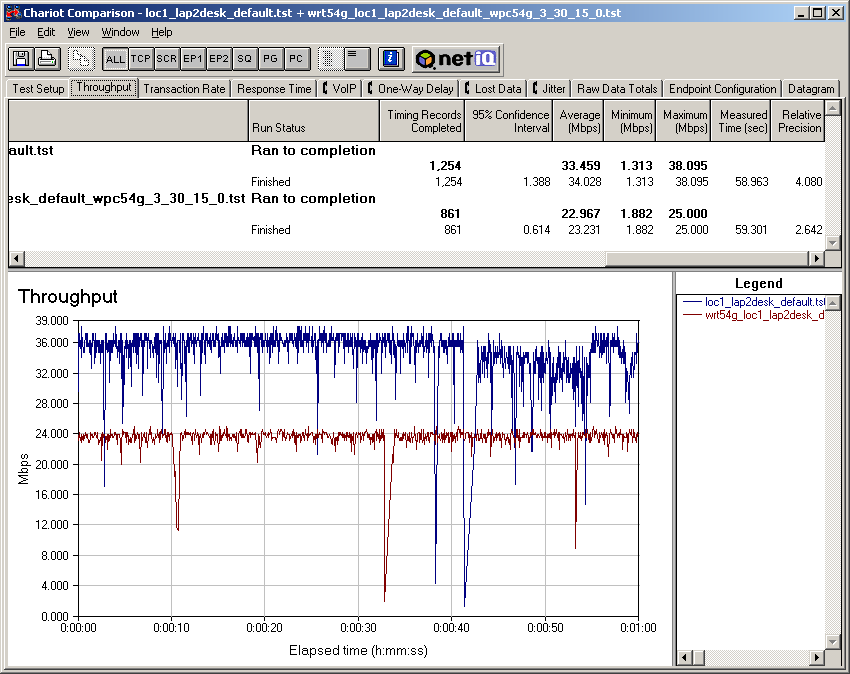
Figure 10: SpeedBoost vs. Previous Generation
(click on the image for a full-sized view)
The plot shows test runs made with each router / client pair about 6 feet apart. Each run had only one router / client pair operating at a time and no other 802.11b or g products in range. The only change I made from router default settings is that on the WRT54G I changed the CTS Protection mode from its default of Disable to Auto and the Frame Burst setting from its default of Disable to Enable. The upper trace shows the SpeedBoosted pair throughput while the bottom is what I got from the WRT54G / WPC54G pair.
The results show a 46.5% (34.0 / 23.2 Mbps) average throughput gain from the SpeedBoosted products, well above Linksys’ promised 35%! Comparisons of maximum and eyeball-averaged speeds yield similar results.
With the first question out of the way, let’s move to seeing how well Afterburner plays with non-Afterburner clients. I performed two more test runs, this time swapping clients between routers to check forward and backward compatibility of the SpeedBooster technology.
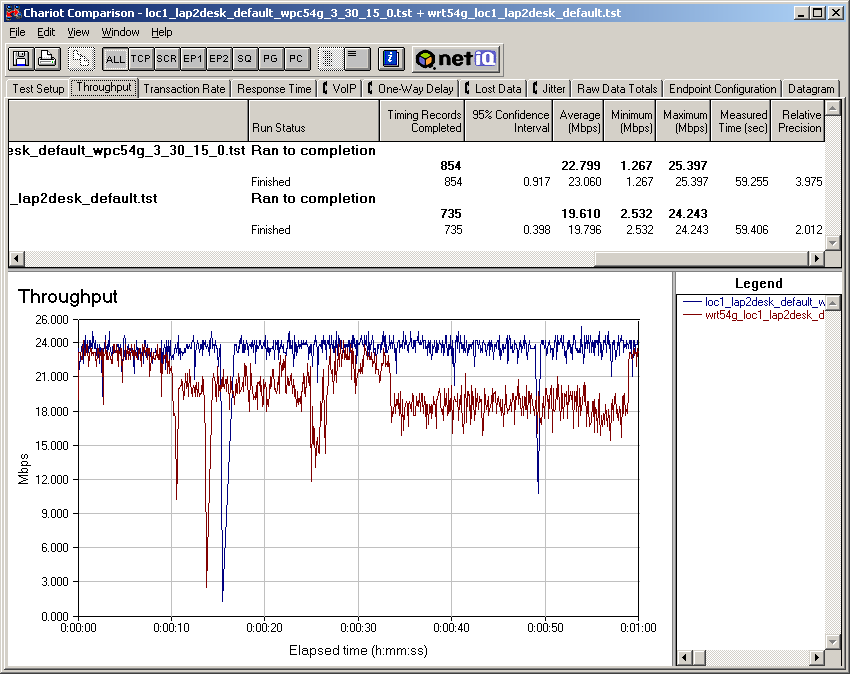
Figure 11: Cross-client test
(click on the image for a full-sized view)
Figure 11 shows that in both cases (the bluish trace is WRT54GS / WPC54G, the reddish is WRT54G / WPC54GS), throughput drops to about 24 Mbps, which from Figure 10 looks like the best case for non-Afterburner performance. This plot also shows that the WPC54GS’ (client card) driver probably has some tuning left to do, since the larger throughput variation seems to follow it.
I also checked to see whether Afterburner had any detrimental effects on non-Afterburner clients.
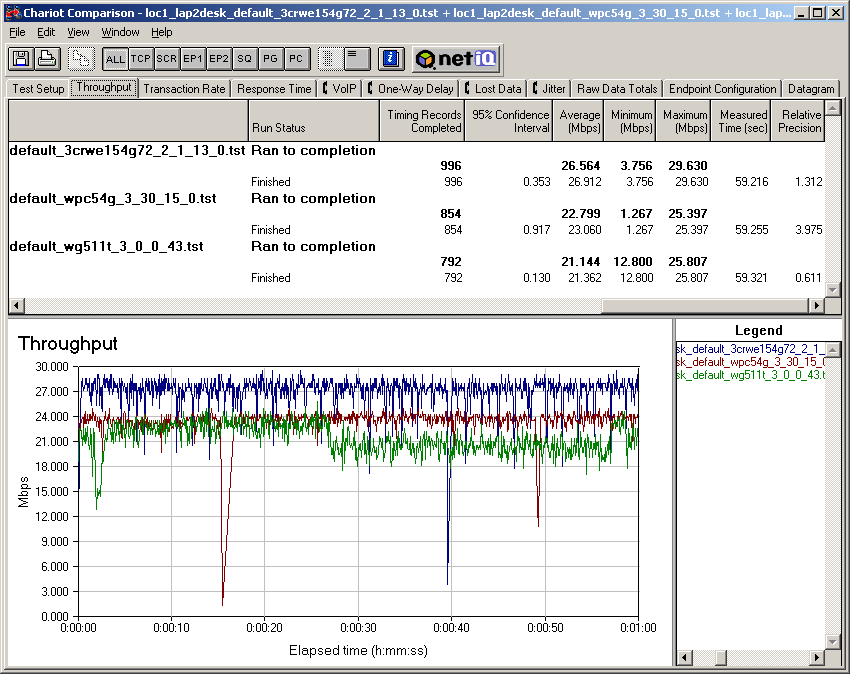
Figure 12: Non Afterburner client comparison
(click on the image for a full-sized view)
Figure 12 shows close range runs using the WRT54GS as the router and with the following clients:
- Linksys WPC54G – Broadcom non-Afterburner chipset [3.30.15.0 XP driver]
- NETGEAR WG511T – Atheros Super-G chipset [3.0.0.43 XP driver (unreleased)]
- 3Com 3CRWE154G72 – PRISM GT chipset [2.1.13.0 XP driver]
I was surprised to find that, with an average throughput of about 27 Mbps, the PRISM GT chipset actually did better than Broadcom’s previous generation chipset when used with the Afterburner-equipped WRT54GS! Although the Atheros-based NETGEAR WG511T’s average throughput number came in almost 10% lower than the Broadcom chipset, the plot shows this is primarily due to higher throughput variation.
Does Afterburner beat Super-G?
So how does Broadcom’s Afterburner stack up against Atheros’ Super-G? Or in product terms, does Linksys’ WRT54GS / WPC54GS pair beat NETGEAR’s WGT624 / WG511T duo? Take a look at Figure 13 and decide for yourself.
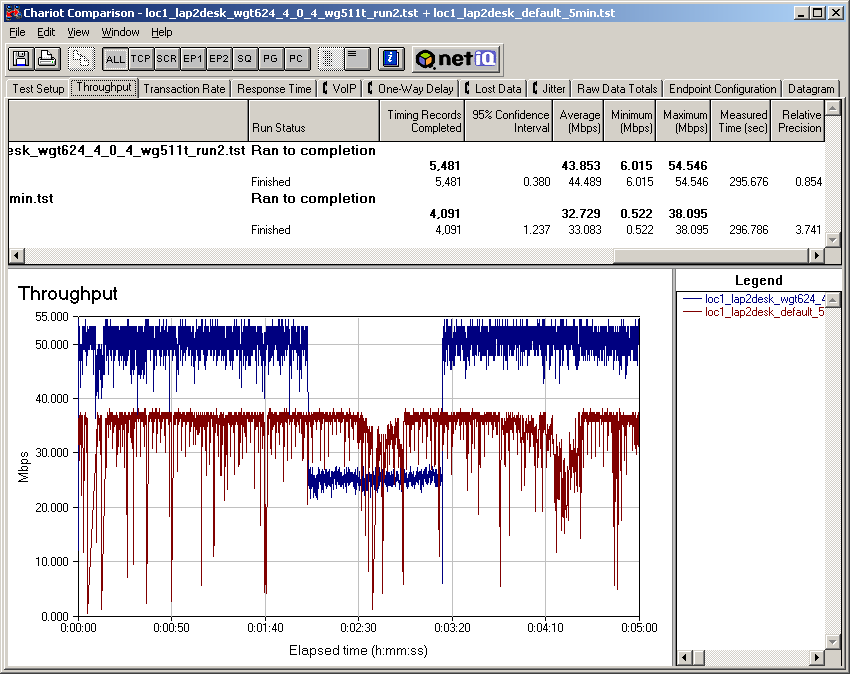
Figure 13: Afterburner vs. Super-G
(click on the image for a full-sized view)
The NETGEAR pair was tested under the same conditions as mentioned before, i.e. close range and no other equipment operating. I did, however, use unreleased firmware and drivers obtained from NETGEAR that are completing QA testing and should be available shortly. I also set the WGT624 router to Auto 108 mode (the card automatically adjusts).
At an average throughput of around 50 Mbps, the NETGEAR products using Super-G clearly beat Linksys’ Afterburner-based offerings, but only when Super-G is running in its controversial channel-bonding mode. As the plot shows, Super-G drops out of channel bonding on a periodic basis to ensure that non Super-G products get a chance to communicate, which lowers its average best-case throughput to about 45Mbps.
But Super-G is supposed to drop immediately out of channel bonding as soon as a non Super-G client comes in range – though it has been Broadcom’s contention that this doesn’t happen. If you assume that Super-G does adjust, however, the speed advantage goes to Afterburner, since its 36 Mbps clearly beats Super-G’s non-bonded 26 (or so) Mbps. On the other hand, as Figure 7 shows, Afterburner’s speed drops pretty quickly with distance and / or obstacles – enough so to question whether Afterburner provides any significant benefit under real-world conditions.
By the way, even though these results (using faster WinXP test computers) are better than I obtained in my previous Super-G testing, I still can’t verify Atheros’ claim that Super-G “will consistently deliver over 60 Mbps of end-user TCP/IP throughput using typical data files”.
Adding It All Up
In the battle for bragging rights to the largest 802.11g throughput number, it appears that Broadcom and Linksys have blinked. Though both companies continue to beat the “good neighbor vs. bad neighbor” anti-Super G drum, they now talk % performance improvement, not absolute throughput. Linksys really seems to have gotten religion – or something else – about backing away from using throughput numbers, since I couldn’t find a reference to any Mbps specs (not even 11g’s normal 54Mbps!) on the WRT54GS or WPC54GS’ product boxes.
In all, I think this is a good thing, because the usable throughput available from any wireless products can never approach the raw data rate due to the extra overhead made necessary by the inherent unreliability of a wireless link. Where the value really lies is in getting the best speed over the widest range, and that’s where the WRT54GS / WPC54GS fail to impress.
As far as the question of whether Afterburner or Super-G is “better”, the answer for many (most?) users is probably neither. The only users who will get the maximum benefit from “enhanced” 802.11g products are those who:
a) Are willing to buy / upgrade all parts of their wireless LAN with products using the same enhancement technology, from the same manufacturer
b) Make sure all parts of their WLAN are operating as the same, latest, firmware and driver revision levels
c) Don’t have any 802.11b WLANs within range
If you don’t meet all three criteria, the premium you’re paying for “enhanced” 11g products is just money wasted, especially if you have 11b WLANs in range. (Street pricing at the time of review puts the premium at about 20% for Linksys’ GS vs. G router and CardBus card.)
The bottom line is that if you liked the WRT54G / WPC54G, you’ll probably like the WRT54GS / WPC54GS too. Just don’t buy it because you think it’ll be significantly faster, because under most real-world conditions, the extra 20% spent will just get you a GS on the nameplate, and fewer blinking lights on the front panel.