

Introduction
7/1/2008 – Corrections to clarify small business as target market
| At a Glance | |
|---|---|
| Product | Polycom SpectraLink Wireless Telephone (8002) |
| Summary | Wi-Fi SIP phone designed for small business use |
| Pros | • Durable construction • Supports strong Wi-Fi encryption • Centrally managed provisioning • Good voice quality • Reasonable battery life • WMM works as promised |
| Cons | • Fiddly initial network configuration • No support for compressed codecs like G.729 • Relatively expensive |
Polycom is a leader in the IP communications space. Not only are their longstanding SoundPoint series of desktop IP phones class leaders, but their voice technology can be found in many products under many names.
Seeing a need to expand their product offering to include cordless mobility, Polycom recently acquired SpectraLink, a leading maker of Wi-Fi-based telephony systems, and Kirk Telecom, a leader in DECT-based cordless telephony systems. These acquisitions, now consolidated under the Polycom name, give the company a comprehensive product suite addressing the mobile IP communications needs of various vertical markets.
The Polycom 8002 is a brand new entry-level Wi-Fi handset designed to fit into SIP-based IP telephony systems. In evaluating the Polycom 8002, it helps to understand the intended target market. This phone is not meant for the average home user with a household WLAN. Instead, Polycom is marketing it to small businesses where there may already be an existing wireless network (WLAN) infrastructure and cordless mobile IP telephony is desired. (Polycom’s 8020 and 8030 handsets using SVP for QoS are geared toward larger enterprises.)
As an example, consider a small chain of retail stores. This type of business may have some form of wide area network (WAN) to connect critical infrastructure like cash registers, inventory and accounting systems, etc. They can also pass voice traffic (VOIP) over their network as a means of connecting locations and reducing telecom costs. Key personnel may further benefit from the ability to move around the store or warehouse while on the phone. They could use cellular phones to provide this mobility, but then they face considerable monthly costs and limited integration into the company PBX.
By using Wi-Fi cordless handsets, a business can address their requirements of providing access to staff, regardless of their location or activity. Properly-designed products can also reduce management overhead and maintain a common configuration and provisioning strategy that can be handled by existing IT or telecom staff.
Even though the Polycom 8002 is better suited to small business needs, I put it to the test over a period of several weeks on my existing home office Asterisk server in conjunction with several SIP desk phones and along side two existing SIP/DECT cordless phone systems.
Product Tour
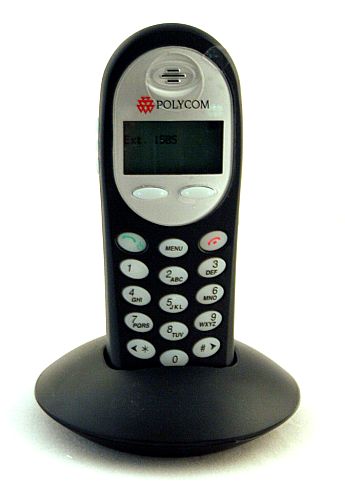
The handset’s case is rugged ABS plastic and should survive being dropped better than most consumer cordless handsets. The buttons are rubberized and have a solid feel. In fact, the buttons are nearly flush with the case and require a firm push to accept a key press. Figure 1 shows the 8002’s keys and display.
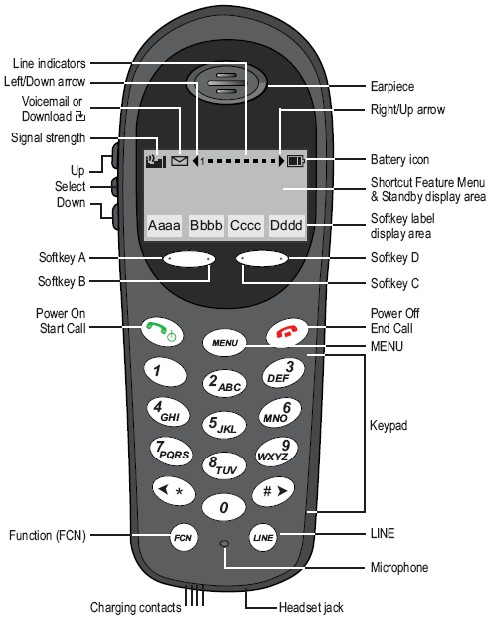
Figure 1: Polycom SpectraLink 8002 Keys and Display
The monochrome LCD display is backlit and has good contrast. The phone’s menus are clearly presented and easily understood on the LCD.
The phone has three settings for microphone sensitivity (Figure 2) in order to compensate for the potential of background noise as might be found in a commercial or industrial setting. In my home office this was not a factor, but it does illustrate the thoughtful design of the phone and attention paid to the target user profile.
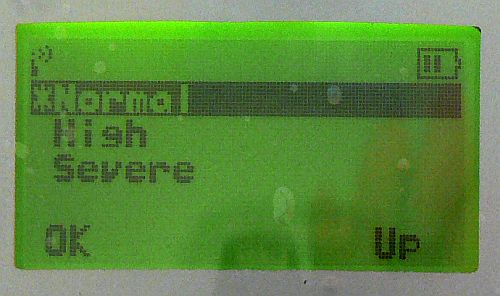
Figure 2: Background noise settings
Internal Details
The FCC ID internal photos aren’t clear enough to make out too many component details. Figure 3 shows a composite of the 8002’s innards with and without the LCD display and keypad.
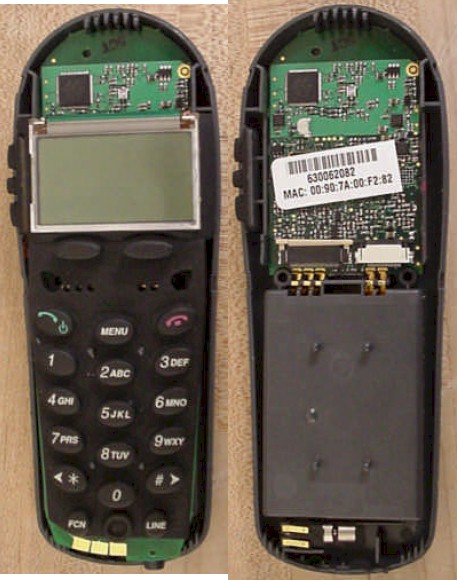
Figure 3: 8002 internal details
Figure 4 shows a closeup of the main board where the only thing you can clearly determine is the SpectraLink custom chip. The 802.11b radio has 100 mW max transmit power.
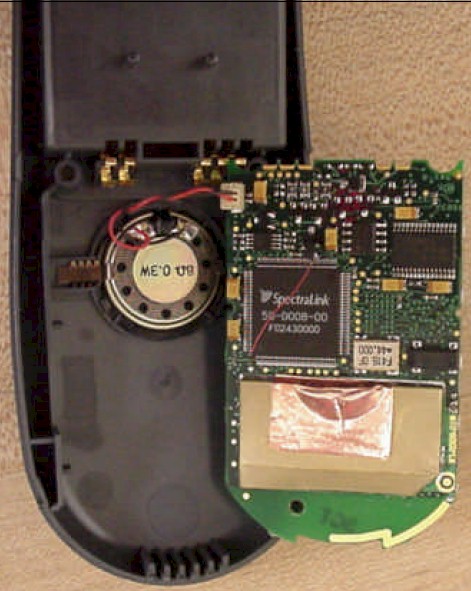
Figure 4: Main board closeup
Wireless Configuration
The first task in setting up the SpectraLink 8002 was to get it on my wireless network. Since this has to happen before the phone can make contact with the provisioning server, all the initial network-connection information must be entered on the handset directly.
It’s at this point that I became familiar with the phones physical attributes. There are three buttons on the left side of the handset. When on a call, these function as volume up & down. When accessing the phone’s menus, they serve as up and down navigation, with the small center button for selection.
During the initial power-on, the phone displays its MAC address. This is handy for locating the phone in a DHCP server activity table. To access the phone’s core network setting you must hold the Power Off button down while tapping the Power On button.
Once into the network setup menu, you need to enter the ESSID (also known as SSID) for the target WLAN and the encryption type. The handset has three modes for ESSID entry, Learn Once (default), Learn Always and Static Entry. Both "Learn" modes scan for APs that are broadcasting ESSIDs and that have a DHCP server. When one is found, the handset retains the ESSID from whichever AP it associates with at that point.
The Learn Once option keeps that ESSID until the ESSID option is reselected in the Admin menu. Learn Always mode automatically reruns the ESSID search process whenever the phone is powered on or when an AP connection is dropped.
The phone supports WEP encryption as well as WPA and WPA2 wireless security. But only the "Personal" form of WPA / WPA2 that uses a Pre-Shared Key (PSK) is supported, which could be a problem for shops that use the "Enterprise" (RADIUS) form. At any rate, the WEP key can be entered either directly in hexadecimal, or as a passphrase that will automatically be converted into hex.
The process of manually entering the SSID and passphrase for the WPA-PSK encryption was a little frustrating. It was a simple matter of becoming familiar with the phone’s user interface while entering long strings.
Based on this experience, I completely understand why the example configs provided with the phone use simple 4 digit numbers for the SIP user login & password. These things are entered into the phone every time it powers on. Thankfully the basic network configuration is entered only once, then retained in the handset.
SIP Setup
The phone’s configuration files are loaded from a TFTP server at power-on. If DHCP is enabled on the handset the DHCP service option 66 must provide the IP address of the TFTP server. This is consistent with Polycom’s established provisioning process for the SoundPoint SIP desk phones. If DHCP is disabled, then all the network parameters, including the IP of the TFTP server, must be manually entered into the handset.
Once the TFTP server is contacted, the phone prompts for a username and password. Based on the username entered, the phone then downloads the associated configuration files. The configuration files are not stored locally on the phone. This is handy, as it allows the phone to be passed from user-to-user, assuming that individuals login when they switch phones so that the handset has the user’s proper extension number.
The core configuration is a two-part system with a file that is common to all handsets on the system (sip_allusers.cfg) and a user-specific file (ex. sip_1505.cfg).
The major benefit of this provisioning scheme is scalability and easy administration. With central provisioning it’s a simple matter to add or remove users, or push a new firmware release to an entire fleet of handsets.
The documentation provided with the phone gives comprehensive, notated examples of the config files. In my case the settings were very simple.
sip_allusers.conf
CODECS = g711u, g711a
PROXY1_ADDR = 192.168.1.200:5060
PROXY1_MAIL_ACCESS = 7999
PROXY1_KEYPRESS_2833 = disable
PROXY1_KEYPRESS_INFO = enable
PROXY1_HOLD_IP0 = disable
sip_1505.conf
AUTH = 1505; 1505
LINE1 = 1505
LINE1_PROXY = 1
LINE1_CALLID = Sip Phone 1505
The phone supports up to five “lines” where each line is a separate SIP registration. A SIP registration may also be entered multiple times allowing for multiple simultaneous call appearances on that line. Each user profile can also contain a list of “favorites” that are effectively speed-dials for that user.
In Use
Two of the fundamental problems facing most Wi-Fi SIP handsets are cordless range and battery life. Simply put, Wi-Fi was not designed with conservation of power consumption as a top priority. So Wi-Fi radios tend to draw considerable power continuously, which can result in lackluster battery life. Ramping down transmit power isn’t a viable power conservation optione, either, since it limits range.
Happily, in the SpectraLink 8002, Polycom has elected to use a substantial NiMH battery. Polycom wouldn’t tell us the battery mAh capacity and there is no marking on the battery pack. But the specified talk time is up to 3 hours, with up to 50 hours of standby operation. I was happy to find that these claims were met over the period of my evaluation. I used the phone over a period of a few weeks without ever feeling that the battery life was a problem.
For heavy users, Polycom offers a charging stand that will charge both the handset and a spare battery, making it more convenient to always have a charged spare battery at the ready. I suspect that serious commercial users will find this option a necessity.
For pure data applications, a WLAN may be designed with spot coverage to provide a data connection to a bank of cash registers, for example. But if you intend to deploy Voice-over-Wi-Fi (VoWifi), then you’ll need good signal coverage over an entire facility.
To help in spotting RF coverage dead zones, the 8002 provides a handy site survey mode (Figure 5). This function provides a real-time readout of the RF signal level of your WLAN as you wander about your facility. When engaged in this mode, the LCD displays the ESSID, RF level, RF channel, WLAN type and security type. You can easily use this tool to map out any holes in your access point layout.
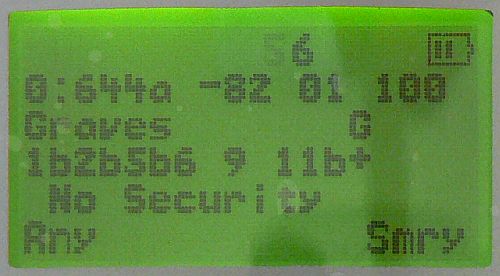
Figure 5: Display with phone in site survey mode
During the few weeks that I used the SpectraLink 8002, it generally served me well. WMM worked as promised; calls were never choppy because of data activity on the WLAN.
Voice quality was in general very good. I was also pleased to find that the handset provides a generous range of volume, which helps me when I’m working near loud server racks.
It takes a little time to get used to using the four function buttons just below the LCD. At first they appear to be two large elliptical buttons, but are, in fact, four separate buttons. Common calling functions like mute, hold, redial and transfer are easily accessed via these buttons.
Wireless QoS a.k.a. WMM
The 8002 has only an 802.11b radio, but it includes support for Wireless Multi-Media (WMM.) WMM is analogous to quality of service (QoS) in a network router, but is designed specifically for wireless networks. This kind of traffic management is required any time you need to ensure absolute continuity of streaming media over a wireless LAN.
When passing voice traffic over your network it’s important that the voice streams get the highest possible priority. This is handled through a mechanism known as “Quality Of Service” or QoS. The necessity of network QoS (or WMM on a WLAN) stems from the fact that in most VOIP installations the voice data (RTP streams) is transmitted using UDP, not TCP.
Within the TCP protocol, there are features that provide for retransmission of dropped or lost packets of data. Regardless of network conditions, all the data sent is received, no matter how long it takes.
Conversely, the UDP protocol does not provide for retransmission of unreceived data. Streaming media sent using UDP might actually lose some data packets to network congestion. The attempts to retry sending lost packets are dropped in favor of trying to maintain a low-latency, real-time stream.
Most network traffic is typically bursty in nature, but VOIP calls and streaming video are not. They are time-sensitive streams of data that need to remain continuous. Without any management of QoS (or WMM in the case of a WLAN) the simple act of checking for email can cause audible breaks in an ongoing phone call. The email client fetching messages can momentarily create a burst of network traffic that saturates some portion of the network. The end result is lost voice packets, and poor voice calling experience.
Polycom is very clear that the 8002 absolutely requires WLAN hardware supporting WMM. So I acquired a new WMM-capable Netgear WNR854T router/AP to replace my very old Linksys WAP54G.
The Polycom 8002 supports both alpha and numeric dialing. It’s much simpler to dial by number from the phone itself, but one can enter a SIP URI directly if required. I found it easier to use SIP URIs in the “favorites” loaded from the provisioning server rather than entering them on the handset manually.
My home and office comprise an area of around 18,000 square feet. With one access point located in my home office, I found that I could reliably use the handset in about 70% of the property. If I were to relocate the access point to a more central position on the property or add a second access point I’m confident that I could use the phone across the entire property.
With the single access point, the useful range of the phone was just a little less than what I’m accustomed to using DECT cordless phones, but considerably more than any previous Wi-Fi handset I have used. I expect that this is as much a result of the newer wireless router as the phone itself.
Conclusion
I must admit that I was prepared to be disappointed with this little phone. My earlier experience with Wi-Fi SIP phones was not good. But the Polycom name gave me reason to expect more from the 8002 and it delivered. The combination of a recent-generation access point and the 8002 proved very capable.
However, this is a system better suited for small businesses and is less suited to SOHO users such as myself. For home use, there is little to be gained by converged VoWifi. DECT solutions, while less scalable, are readily available, inexpensive and easily deployed beside Wi-Fi networks.
However, for businesses that are already on a path to voice/network convergence, the Polycom 8002 is a viable option for implementing VoWifi as an aspect of their telecom strategy.