

 Apple’s new Airport Extreme doesn’t offer anything new for those looking to trade up to draft 802.11ac.
The ME918LL/A version of Apple’s AirPort Extreme introduced on Monday doesn’t have anything to make it more attractive to buyers than other draft 802.11ac routers that have been out now for over a year.
In fact, Apple has stuck with its convention of three vs. the usual four LAN ports, which continues to be an odd way to save a little manufacturing cost. And the choice of USB 2.0 vs. 3.0 is a step backwards, considering the most of the new crop of draft 802.11ac routers come with USB 3.0 ports.
Even the vertical "mini-tower" design has been done already in D-Link‘s routers. If you want to save desktop space and don’t mind black, the DIR-868L uses Broadcom’s second-generation dual-core BCM4708 processoar and also has a USB 3.0 port.
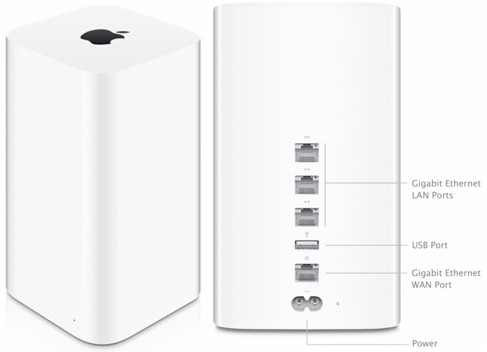
Apple AirPort Extreme (ME918LL/A – draft 802.11ac)
It’s nice that the new Extreme supports beamforming. But remember that devices also need to support it to get any real benefit and they have to be using draft 802.11ac, too.
If Apple really wanted to get a jump on the competition, it would have put multi-user MIMO (MU-MIMO) into the new Extreme. This would have made it much more efficient in handling the coming onslaught of mobile devices running draft 802.11ac, including the new MacBook Airs (but not yet the iPhone).
Still, Apple fans will be sure to line up and pay top dollar ($199) for the Extreme or the new draft 802.11ac Time Capsules that were also announced. After all, if it’s from Apple, isn’t it better by definition?