

Introduction
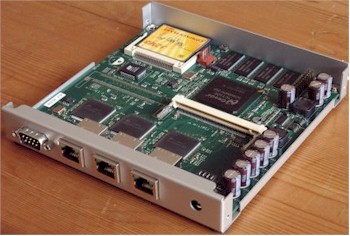
| PC Engines Wireless Router Application Platform | |
|---|---|
| Summary | Embedded PC based on 266 MHz National Geode processor. Perfect for m0n0wall installations. |
| Update | None |
| Pros | • Lower cost than Soekris equivalent • Supports PoE |
| Cons | • Optional case is amateurish • Lacks PCI, USB and ATA / IDE interfaces • Case makes CF slot access difficult |
Last month I reviewed the m0n0wall firewall, a FreeBSD distribution optimised to run from CompactFlash media on Embedded PC devices. As part of that review, I looked at the Soekris net4501, one of the Embedded PC devices that m0n0wall has been optimised for.
This time round I am going to look at the PC Engines WRAP Embedded PC device, an alternative to the Soekris net4501.
Features
PC Engines GMBH are based in Zurich, Switzerland and make a range of specialist PC related products, from PCI / ISA bus test tools, IDE CompactFlash adaptors to their Wireless Router Application Platform (WRAP) embedded PC device. The WRAP has many similarities with the Soekris net4xxx range of Embedded Devices, though performance-wise is more comparable with the net4801 than the net4501 that was examined in the previous review.
Below is a table giving a quick comparison on price and specification between the PC Engines WRAP and Soekris net4501 and net4801 embedded PCs. The prices reflect recent price reduction from both PC Engines and Soekris.
| Supplier | Version | CPU | RAM | Price * |
| PC Engines www.pcengines.ch |
WRAP.1D-2 | 266 MHz National Geode SC1100 |
64MB | $157 |
| 3 LAN / 1 miniPCI, CF, Serial, Power Over Ethernet, Case | ||||
| Soekris www.soekris.com |
net4501-30 | 133 MHz AMD ElanSC520 | 64MB | $185 |
| 3 LAN / 1 miniPCI, CF, 3.3vPCI, Serial, Case | ||||
| net4801-50 | 266 MHz NSC SC1100 | 256MB | $253 | |
| 3 LAN / 1 miniPCI, CF, 3.3v PCI, 2 Serial, USB1.1, UltraDMA-33, Case |
||||
* Prices as advertised 29 September 2004, exclusive of shipping and taxes.
The WRAP.1D-2 is one of a range of three board configurations, which differ on the number of Ethernet and miniPCI interfaces they provide. However, the optional case is currently only available for the 3 Ethernet interface WRAP.1-2.
Since the WRAP.1C-2 device reviewed here was purchased, it has been superseded by the WRAP.1D-2. The change in revision is mainly to reflect that the manufacturing has moved from China to Taiwan. The cases are now also available in anodised red and black in addition to the aluminium finish. See the WRAP accessories pages on the PC Engines website for more details.
A summary of the WRAP.1C/D-2’s specifications are:
- 266 MHz National Geode SC1100 CPU
- 64 MB SDRAM
- CF Type I/II socket
- 3 auto-sensing 10/100 Mbit Ethernet ports, RJ-45
- 1 Serial port, DB9
- Three front panel LEDs
- Mini-PCI type III socket.
- Power, 3 to 5W at 12V DC supplied through DC, acceptable range +7V to +18V
- Passive Power over Ethernet
While the 266 Mhz processor on the WRAP makes it comparable to the Soekris net4801 in terms of performance, other features of the net4801 such as the ATA33 and USB1.1 interfaces and 3.3v PCI slot are absent. The WRAP supports passive Power-over-Ethernet (PoE) on the LAN1 interface, this comes into its own when the main board in being used for a wireless router or access point.
Internal Details
Up until recently, the WRAP devices were only available as the bare-board. This has recently been addressed by the introduction of an optional anodised and pressed aluminium case. But the way PC Engines have implemented the case has its advantages and disadvantages.
On the plus side there is no doubt (in my opinion anyway) that the anodised aluminium finish is much more attractive than the odd shade of green of the powder-coated steel Soekris cases. A complete absence of branding decals and case markings also lends the case to OEM use. The use of pressed aluminium has resulted in the PC Engines WRAP being positively light-weight, around half the weight of the Soekris net4501 at 384g (0.9 lb) compared to 750g (1.6 lb). Externally, the case measures 158mm X 155mm X 25mm (6.2 in. X 6.1 in. X 1 in.).
Tip: After a bit of digging around prompted by a rumour on the m0n0wall mailing list about a black case for the Soekris net4501, I can confirm that they indeed exist and are distributed by kd85.com in Belgium.
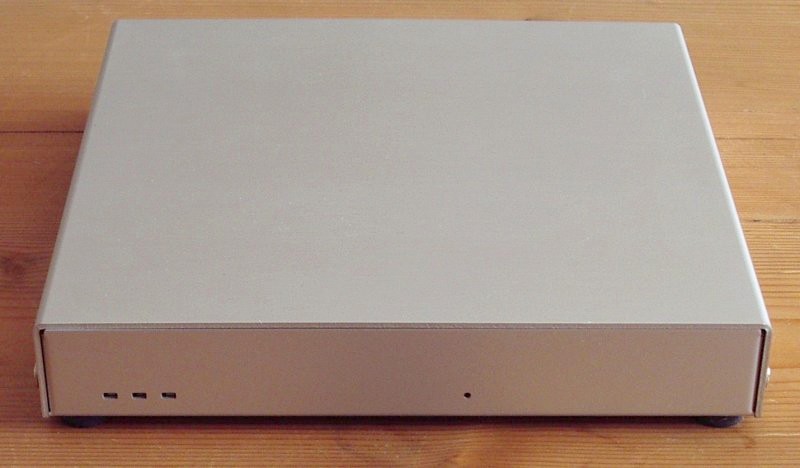
Figure 1: PC Engines WRAP, Front View
The front of the WRAP has three LEDs mounted directly on the board and a small recessed reset switch, again mounted on the board. Under m0n0wall only the left-hand most LED is functional as a power indicator, the remaining LEDs and the reset switch are not implemented at present by the m0n0wall software.
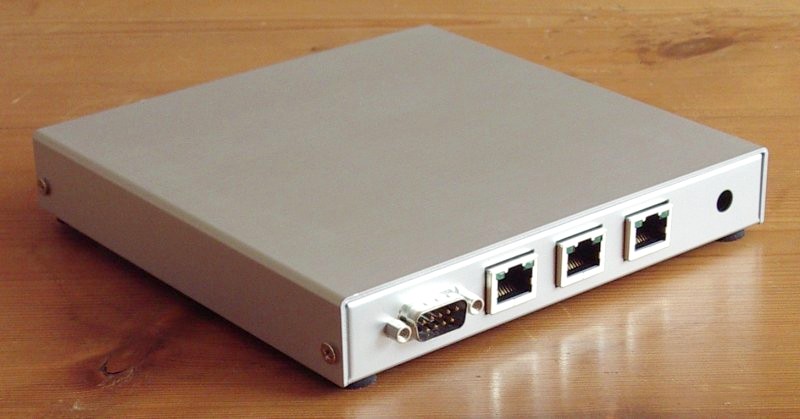
Figure 2: Rear View
As on the net4501, the rear of the WRAP has from right to left, the 12V power connector, 3 X RJ45 Ethernet interfaces and a DB9 Serial Console interface. The right-hand most Ethernet interface (LAN1) supports passive Power-over-Ethernet.
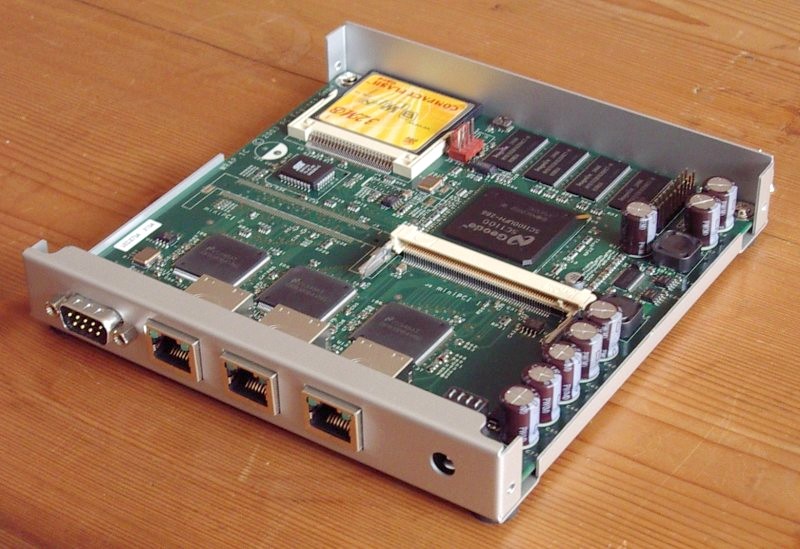
Figure 3: Top Cover Removed
On the minus side, the top and bottom of the case are held together by four self-tapping countersunk head screws that fix at each corner. This, I think, gives the case a slightly home-made appearance. The anodised aluminium finish is also relatively easily scratched, something I discovered when clumsily fixing one of the self-tapping screws first time. More importantly in-use, the CompactFlash card is not very easily removed as the case and board have to be partly disassembled, something that will quickly become tiresome if you have to re-flash the contents of the card often. This said, once installed, there is no chance of the CompactFlash card being dislodged during transit etc.
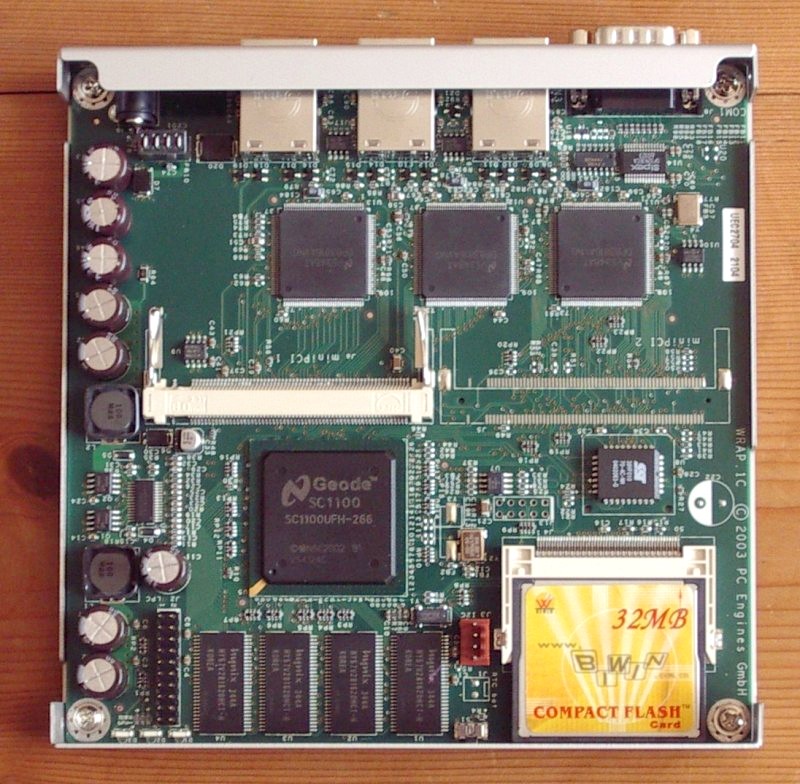
Figure 4: PC Engines WRAP Main-Board
Performance Tests
In use, the WRAP is largely the same as the Soekris net4501. Installation of m0n0wall is identical, as is the initial configuration (please see the previous review for details). For the purposes of using m0n0wall as an Ethernet firewall, the only real differences are the processors, cases and price. With the WRAP you get the faster 266Mhz processor which has quite a significant effect on the performance over the 133 MHz processor of the Soekris net4501. Available SDRAM is 64MB in both.
However, colour preferences aside, there is no doubt that the Soekris case is the more professionally finished, with no screws visible once assembled and the ability to remove the CompactFlash card without removing the main board.
Below are two sets of performance data provided by Manuel Kasper showing the throughput of the firewall under NAT and packet filtering, and throughput of an IPSec VPN.
|
Manufacturer |
Platform
|
NAT Test, Mb/s
|
IPsec Test, Mb/s
(3DES-MD5) |
||
| LAN -> WAN | WAN -> LAN | LAN -> WAN | WAN -> LAN | ||
| PC Engines | WRAP.1C-2 | 38.3 | 42.8 | 3.64 | 3.52 |
| Soekris | net4801-30 | 25.3 | 33.6 | 3.85 | 3.76 |
| net4501-50 | 16.5 | 18.5 | 2.07 | 2.02 | |
As you can see, the WRAP is certainly no slouch. What is surprising is its packet filtering and NAT performance relative to the Soekris net4801, with which it shares the same processor and Ethernet interfaces. Somehow the WRAP performs 50% better than the net4801 outbound and 27% inbound.
Manuel Kasper’s explanation for this is:
“….I think I now know why the net4801s forwarding performance was inferior to the WRAP: the three NICs share IRQs on the net4801, whereas each NIC has its own IRQ on the WRAP. Due to a bug in the FreeBSD sis driver, if one NIC is disabled (as was the case with the third NIC in my tests), the driver spends lots of time trying to stop the already stopped interface during an interrupt. This has been fixed in [ed: m0n0wall] 1.1b17 (and the fix is also in 1.1). I’d expect performance to be about the same now (I haven’t checked though).”
In the IPSec VPN test the net4801 catches up somewhat overtaking the WRAP by a small margin. This is again explained by Manuel as due to the tests being performed with an early beta test board of the WRAP.1C that had a 233 MHz processor (vs. 266MHz in the current product).
|
 Testing Notes
Summary and Conclusions
For many people, ‘bang for buck’ will be a major consideration when choosing between the two platforms. On the basis of running m0n0wall as an Ethernet firewall there is little reason not to choose the PC Engines WRAP, since it provides better or essentially equivalent performance for less money, depending on which Soekris product you compare it to.
On the other hand, while relatively more expensive, the Soekris net4xxx line is the more professionally finished and could prove more flexible than the WRAP. This conclusion is based on the net4501 having a 3.3V PCI slot which can be used in conjunction with a suitable PCI card to provide a wireless network interface. The net4801 adds to this with both UltraDMA-33 hard disk and USB1.1 interfaces. Note also while both the WRAP and Soekris devices are FCC certified, anyone considering distributing the WRAP within the European Union (EU) market should give consideration to its lack of CE marking.